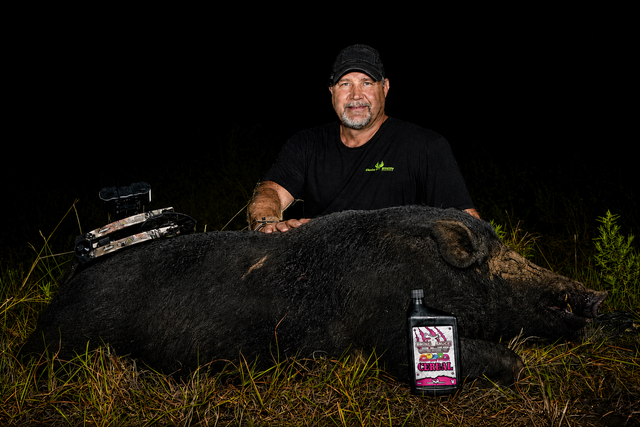
By Chad Stevenson | President, Elusive Wildlife Technologies
I’ve been hunting hogs at night for more than 30 years, and one of the most valuable tools I’ve ever used is a remote control for my feeder. I estimate that 50–80% of the hogs I’ve taken involved using a feeder remote to my advantage. That’s my firsthand estimate from decades of hunts, many of which I’ve filmed, not a formal statistic.
I’ve tried competing feeder remotes over the years. For power consumption, range and dependability, nothing I’ve used comes close to THE-REMOTE. Here’s why I keep using it.
Quick Answer: Why I Recommend THE-REMOTE
After decades of use, I recommend THE-REMOTE for its low power consumption, dependable performance and practical range. It lets me activate a feeder when timing matters, and one transmitter can operate multiple compatible receivers.
A Remote Can Change the Outcome of a Hunt
Imagine hearing hogs approach your feeder at night. The feeder is scheduled to run in another five or ten minutes, but they’re coming from the wrong direction and may cross your scent before then. Without a remote, you can only wait. With THE-REMOTE, I can spin the feeder immediately. Often, the sound and fresh corn draw them straight toward the feeder before they get downwind of me.
I prefer to keep my feeder on its normal schedule when possible. But when hogs are about to catch my wind, I don’t hesitate to use the remote. Once a hog smells you, getting it back is much harder.
How I Bring Hogs Back After the First Shot
When I bowhunt, I attach the transmitter to my bow with Velcro so it’s always within reach. After I take a hog, I wait until it runs out of sight of the others, then spin the feeder again. The remaining hogs often come right back to the corn. We’ve had opportunities at two or three hogs from the same group, and on exceptional hunts we’ve continued until we ran out of arrows.
It can also help if I accidentally bump the stand and startle hogs that were already feeding. It doesn’t work every time, and hogs that have actually caught my scent are much less likely to return. But I’ve seen this technique work over and over.
The Biggest Difference: Extremely Low Power Consumption
Years ago I bought an inexpensive feeder remote, and the feeder battery seemed to be dead every time I went hunting. I added one solar panel, then another, and eventually needed four just to keep that setup going. Another brand took three panels. Those supposedly cheap remotes ended up costing me a lot more than their purchase prices.
THE-REMOTE has been completely different in my experience. Its low-power receiver design avoids the excessive battery drain I saw with those other remotes. I’ve operated feeders with THE-REMOTE and no solar panel at all. You do not need to add a solar panel just to power this remote.
Of course, how long any feeder battery lasts still depends on the feeder motor, timer, battery condition and how often you feed. My point is that THE-REMOTE has not caused the battery-drain problems I experienced with competing remotes.
About 35 Units in the Field—and No Receiver Failures
I have around 35 THE-REMOTE units in the field, including some I’ve used for decades. I’ve never had a single receiver go bad. When one has stopped responding, the issue has been a weak or defective battery in the handheld transmitter. I once bought replacement batteries that were bad right out of the package; installing good fresh batteries got everything working again.
That’s why I say you get what you pay for. Reliability means a lot when you’ve driven out to hunt and need the equipment to work.
Range, Antennas and Installation
THE-REMOTE is designed for a range of approximately 175 yards. I’ve occasionally had one work from about 300 yards in favorable conditions, but I would not count on that distance everywhere. Brush, terrain and the feeder itself can affect reception.
For close bowhunting setups, I often leave the receiver and small antenna inside the feeder control box. For longer-distance use, I prefer an externally mounted antenna. An available extension antenna can also help on large low-profile feeders, where a hopper full of corn may block the signal to a receiver mounted low on the opposite side.
THE-REMOTE works with both 6V and 12V feeder systems and includes installation components. It is particularly easy to connect with THE-TIMER, a separately branded timer designed to work with it. Most other feeder timers can also be used, though they may require additional wiring.
Five-Second Feed Cycle—and Multiple-Feeder Value Packs
A normal activation spins the feeder for about five seconds. The duration is not a programmable setting, but I can extend the run by continuing to hold the transmitter or activating it again as the motor starts. I often use roughly ten seconds when I want more corn on the ground.
One transmitter can operate multiple compatible receivers. At Elusive Wildlife Technologies, we offer value packs with two receivers and one transmitter, so hunters with more than one feeder can save money compared with buying two complete systems.
It Works for Deer Hunting, Too
I once had a target buck come through chasing a doe. He was so focused on her that he showed no interest in my feeder. I spun the feeder, and he stopped to look, but then followed her again. I spun it a second time. This time he turned and came back toward the feeder, and I eventually took him with my bow.
That hunt is a perfect example of why I value remote control. Where feeder use is legal, it gives you another way to influence an animal’s movement at exactly the right moment.
Is THE-REMOTE Worth the Price?
THE-REMOTE isn’t cheap. But I’ve tried the inexpensive alternatives, dealt with dead batteries and bought extra solar panels. I judge a feeder remote by whether it works when I need it, how much power it uses, its practical range and whether it keeps working year after year.
After roughly 30 years of experience, THE-REMOTE is the best feeder remote I’ve used. For serious hog hunters, I believe dependable remote control can be one of the most useful additions to a feeder setup.
Chad Stevenson is president of Elusive Wildlife Technologies and has spent more than 30 years hunting hogs at night and approximately 25 years developing and supplying nighttime hunting equipment.
Shop THE-REMOTE
Explore THE-REMOTE systems, compatible THE-TIMER options, extension antennas and multi-receiver value packs at Elusive Wildlife Technologies.
Find similar articles:
best feeder remote deer feeder deer feeder remote feeder remote remote control the remote timer with remote wildlife feeder