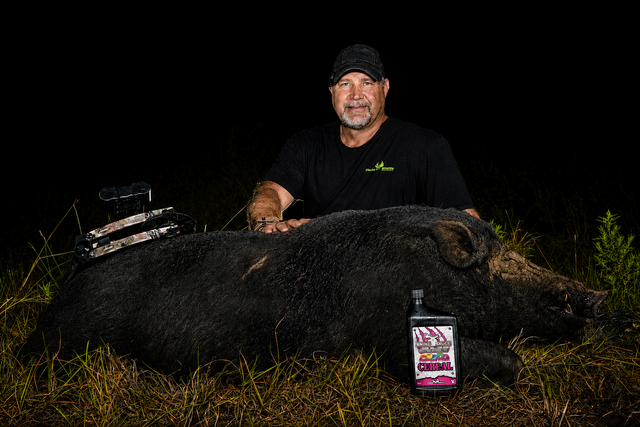
After more than 25 years of hunting hogs at night, I’ve learned that success usually isn’t determined by one piece of equipment or one trick. It comes from stacking small advantages in your favor: wind, trail-camera information, timing, a quiet approach, good light placement, and knowing when to stay patient—or when to leave.
The Quick Guide
• Wind comes first. If the wind is wrong, hunt another setup.
• Check the trail camera before walking in. Hogs may already be there.
• Get there early. Don’t risk bumping hogs that are already moving toward the feeder.
• Prepare your approach ahead of time. Clear sticks, leaves, weeds and anything that can make noise.
• Let hogs settle before forcing a shot. Relaxed hogs usually give you better opportunities.
• Don’t educate them. If the wind shifts against you, leaving can be better than ruining the setup.
1. Start With the Wind
Before I start toward a feeder, I check the wind. It determines how I approach and sometimes whether I hunt that feeder at all. I also check the trail camera immediately before going in. Knowing hogs usually arrive at a certain time doesn’t mean one isn’t already standing there.
If a mature boar gets directly downwind of me, I’ve heard them make a deep, guttural growl. In my experience, when I hear that, the hunt at that setup is generally over. If the wind shifts while I’m hunting and looks like it’s going to stay wrong, I’d rather get out and move than let the hogs smell me.
Don’t sacrifice tomorrow’s hunt trying to save tonight’s hunt.
2. I Prefer Darker Nights
It isn’t necessary to hunt around a new moon, but when I have a choice, I prefer the darker nights of the month. Hogs may not have great eyesight, but they can still detect movement and silhouettes. I’ve had hogs look straight up at me when I was exposed in an elevated setup.
I try to keep good cover behind me instead of sitting against open sky. Less moonlight gives me another small advantage, and my hunting lights also appear brighter against a darker environment.
3. Do the Noisy Work Before the Hunt
If I haven’t hunted a setup recently, especially during summer growth, I may arrive a day early with a weed eater and prepare the route to my stand. At some locations I rake leaves and sticks off the trail until I’m walking on relatively clean dirt. I trim briars, limbs and vegetation, clear shooting lanes, and make sure nothing blocks the camera when we’re filming.
I also check stands, platforms and chairs. After one heavy rain, a buddy opened a folding camera chair above me and dumped a load of cold rainwater straight down my back—with a hog already feeding about 15 yards away. I somehow stayed quiet and we got the hog, but it reinforced a simple rule:
Do the noisy work before the hunt.
4. Make the Final Approach Like Hogs Are Already There
When possible, I use a quiet electric side-by-side and commonly park 300 yards or more from the feeder, depending on the location. I approach from downwind and stay quiet from the moment I leave the vehicle. As I get closer, I get progressively slower and more careful. When bowhunting, I’m often only 15–20 yards from the feeder.
I prefer soft-soled footwear when conditions allow because it helps me move quietly and feel what is under my feet. A recent rain can be a big advantage too—wet grass, leaves and sticks are much quieter. At one setup, we often approach along damp ground near the water for exactly that reason.
And I stop and listen. If I hear something, everybody with me stops. We’ve had hogs traveling the same trail we were using to reach the stand. Continuing blindly can bump the very hogs you’re trying to hunt.
5. Keep the Corn Where You Want the Hogs
One simple modification I use is doubled roof flashing secured beneath the feeder with self-drilling screws. It helps keep scattered corn concentrated around the feeder instead of throwing feed 50 feet toward my stand or approach route. I want the hogs feeding under the light, not wandering around looking for stray corn where they’re more likely to cross my scent.
It also makes the feeder louder. When a strong feeder motor throws corn against that metal, the sound carries. Hogs that regularly use feeders learn that sound means food. To me, it’s a dinner bell.
6. Use the Feeder to Your Advantage
One of my hardest locations is a creek setup that also holds some of our biggest hogs. Hogs approach from multiple directions and the wind and thermals can swirl through the creek bottom.
At that location, once I’m within reliable range of THE REMOTE while still far enough away not to bump them, I may stop and spin the feeder. I’ve heard hogs get up from different directions and run toward the feed. Once they’re concentrated under the feeder, competing for corn and making noise, that commotion can help cover the final part of my approach.
The lesson isn’t that every setup should be hunted the same way. Learn your setup and adapt your approach to what the hogs are actually doing.
7. Let the Hogs Settle—and Be Patient With Big Boars
When a sounder arrives, I usually let them start feeding and calm down before forcing a shot. Once they’re comfortable, they’re less skittish and usually give me better opportunities. It also gives additional hogs time to arrive.
Trail cameras help me decide how patient to be. If I know a particularly good boar has been regularly visiting, I may wait much longer. I’ve watched mature boars hang outside a setup for 10, 20, 30 or 45 minutes, and occasionally close to an hour, before committing. Sometimes the only clue is a silhouette or the sound of one shaking its head and flopping its ears.
But conditions still make the decision. If the wind becomes questionable or the hogs get nervous, I don’t necessarily want to look a gift hog in the mouth.
8. After the First Hog, Don’t Assume the Hunt Is Over
After a good shot, once the hog has run far enough that I believe the remaining hogs can no longer see it, I’ll often spin the feeder again with THE REMOTE. I’ve repeatedly watched hogs that were starting to leave turn around and come back to fresh corn.
I jokingly call it pushing the hogs’ reset button. I can’t tell you exactly what they’re thinking; I can only tell you what I’ve watched happen over many years. With a bow it can be especially effective because there is no rifle report. We’ve had nights where we continued taking hogs until we literally ran out of arrows.
9. Don’t Burn Out a Productive Setup
Having more than one feeder location gives you options and lets you rotate pressure. Most hunters don’t need anything close to the number of setups I use. Even two or three good locations can make a major difference if your property allows it.
I’ve gone back to the same feeder the very next night and taken more hogs, so I don’t follow an arbitrary rest schedule. I watch the hogs. When they begin associating a location with danger, I’ve seen them become more cautious, circle longer before committing, or temporarily avoid the feeder.
The Biggest Lesson
If you already have hogs showing up on camera, don’t overcomplicate your first nighttime hunt. Know the wind. Get there before the hogs. Prepare your approach. Stay quiet. Use cover. Let the hogs settle. And don’t force a bad situation.
Good equipment helps, but equipment works best when everything around it is right. Some of my most successful hunts happened because of little things I did hours—or a day—before I ever climbed into the stand.
Stack enough small advantages in your favor, and eventually they become one big advantage.
Related EWT Guides
• Red vs. Green Lights for Hog Hunting: Which Color Is Better?
• Which Hog Feeder Light Should I Buy? A Simple Guide to Choosing the Right Feeder Light
• How to Get Hogs Used to a Feeder Light Without Spooking Them
More stories

How to Get Hogs Used to a Feeder Light Without Spooking Them